.jpg%3F2026-06-17T07%253A11%253A01.623Z&w=3840&q=100)
With 10 Express Entry selection categories for Canada PR in 2026 and continuous evolution in Canada immigration policies, French language proficiency has emerged as one of the game changing factors for prospective immigrants who wish to seek Canada permanent residency in 2026.
Undoubtedly, Express Entry has remained one of the most reliable and fastest pathways alongside other Canada PR pathways such as the Provincial Nomination Program (PNP) or Atlantic Immigration programs. With the introduction of category based selections under the Express Entry program, the country aimed at creating new opportunities for applicants with skills and qualifications. Among several categories, French language proficiency has constantly stood out as one of the most favourable pathways, offering lower CRS scores requirements, additional ranking scores, and dedicated invitation rounds. So, if you are fluent or planning to learn French as an additional language then this complete guide will help you navigate how this pathway could be the route to your destination.
Why Canada is Prioritizing French Language Speaking Immigrants in 2026
Canada, a bilingual country with two official languages English and French, continues to attract skilled workers and professionals proficient with one of these two languages. As part of its long term immigration strategy the country continues to attract professionals who can actively contribute to its economic growth while supporting its linguistic diversity. Alongside Quebec several provinces including Ontario, New Brunswick, Manitoba, Nova Scotia, and Prince Edward Island, actively promote Francophone immigration to strengthen their French-speaking communities.
With six dedicated draws and a total of 30,500 ITAs issued thus far in the first half of 2026 indicate Canada’s intention of strengthening French speaking communities outside Quebec and across the provinces of Canada while addressing labour shortage.
Benefits of French Language Proficiency for Canada PR in 2026
The French language offers several benefits to eligible skilled professionals who wish to seek better career opportunities in Canada and secure permanent residency in 2026. As Canada continues to expand its Francophone immigration targets, bilingual applicants will get these benefits:
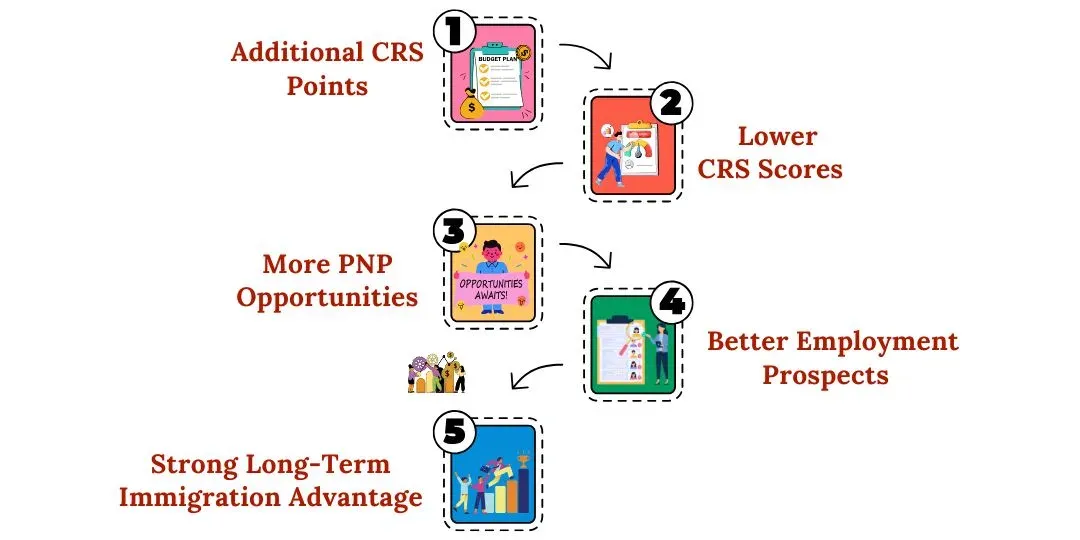
❖ Additional CRS Points
Applicants applying for Canada PR in 2026 through the French language proficiency category, can earn additional 50 points to their CRS scores. These points can significantly improve an applicant’s ranking and increase the chances of receiving an Invitation to Apply (ITA).
❖ Lower CRS Scores
As per the latest invitation rounds, the French language proficiency invitation rounds have invited applicants with the minimum scores ranging between 393 to 419. These scores are comparatively lower than general Express Entry draw categories such as PNP, CEC or many other respective categories. With the additional benefit of 50 points, eligible applicants with even lower CRS scores can also successfully receive an ITA for Canada PR in 2026.
❖ Increased Provincial Nomination Opportunities
Several provinces actively seek French-speaking skilled workers through their dedicated PNP pathways. Provinces such as Ontario, New Brunswick, Nova Scotia offer additional pathways for Francophone communities.
❖ Better Employment Prospects
Bilingual professionals are highly valued in the Canadian labour market. Employers in sectors such as healthcare, education, customer services, government services and administrative services often prefer candidates who can communicate well in English and French.
❖ Strong Long-Term Immigration Advantage
Canada’s continuous effort in attracting French-speaking skilled professionals indicates the country's commitment to offer long term immigration advantages such as better lifestyle, employment opportunities, education and healthcare facilities.
Considering these advantages, it is evident that French language proficiency has become one of the most valuable assets for applicants seeking Canada permanent residency in 2026. From dedicated draws, to additional CRS points, to provincial nomination pathways, French-speaking candidates enjoy a significant competitive edge in Canada’s immigration system.
French Language Category Draws in 2026
Of the 30 Express Entry draws held in 2026, 6 were dedicated French language draws — issuing 30,500 invitations to French-proficient candidates. The trend of 6 draws in the first half of the year, demonstrates Canada’s intention of attracting bilingual talent who can actively contribute in accelerating its economic growth. Here is a dedicated list of draws held in 2026 under the French category with their CRS scores and invitations issued.
Draw Date | CRS Scores | Total ITAs Issued |
May 28, 2026 | 409 | 4,500 |
April 29, 2026 | 400 | 4,000 |
April 15, 2026 | 419 | 4,000 |
March 18, 2026 | 393 | 4,000 |
March 4, 2026 | 397 | 5,500 |
February 6, 2026 | 400 | 8,500 |
From the abovementioned table it is evident that the first draw of the year invited a total of 8,500 applicants with a mere CRS score of 400. And with this, the trend followed till date, larger invitations with lower CRS scores, giving ample opportunities to skilled professionals to build a secure and stable future in Canada. The CRS scores have ranged barely between 393 to 419, to which the Express Entry system also allocates additional points for the French language as a secondary language.
Minimum French Language Requirements for Canada PR in 2026
Eligible skilled professionals who hold fluency in the French language or aspiring learning aspirants planning to apply for Canada PR in 2026 through the French language category must understand certain eligibility requirements. To qualify under the French language proficiency category candidates are required to demonstrate their language skills equivalent to NCLC 7 in all of the four modules (reading, writing, speaking, and listening) through certified language tests.
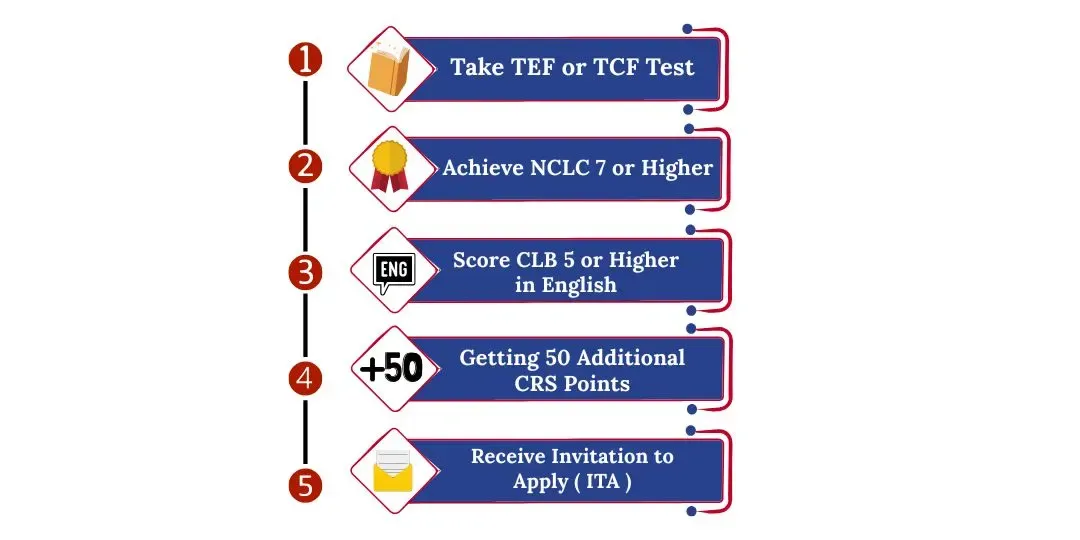
The approved French language tests applicable for Canada PR in 2026 are:
❖ TEF – Test d'Évaluation de Français
❖ TCF – Test de Connaissance du Français
As earlier mentioned, Canada, being a bilingual country, accepts both English and French for official language tests reports, applicants with both language skills have an advantage while receiving invitations to apply. Let us understand how this works with an example:
Example – Mr. Jatin Arora, fluent in both languages, aspires to apply for Canada PR in 2026. As he is comfortable and fluent in both languages, he can use his English language skills as his First Official Language, giving ample points to his CRS score card. Afterwards, he can also use his French language skills as the Second Official Language, giving him an advantage of additional points.
Official languages proficiency - first official language
Maximum points for each ability (reading, writing, speaking and listening):
● 32 with a spouse or common-law partner
● 34 without a spouse or common-law partner
CLB (Canadian Language Benchmark) Level Ability | With spouse or common-law partner | Without spouse or common-law partner |
Less than CLB 4 | 0 | 0 |
CLB 4 or 5 | 6 | 6 |
CLB 6 | 8 | 9 |
CLB 7 | 16 | 17 |
CLB 8 | 22 | 23 |
CLB 9 | 29 | 31 |
CLB 10 or more | 32 | 34 |
Official languages proficiency - second official language
Maximum points for each ability (reading, writing, speaking, and listening):
● 6 with a spouse or common-law partner (up to a combined maximum of 22 points)
● 6 without a spouse or common-law partner (up to a combined maximum of 24 points)
CLB (Canadian Language Benchmark) Level Ability | With spouse or common-law partner | Without spouse or common-law partner |
Less 4 or less | 0 | 0 |
CLB 5 or 6 | 1 | 1 |
CLB 7 or 8 | 3 | 3 |
CLB 9 or more | 6 | 6 |
By using English as his first official language and French as his second language, Mr. Jatin can secure points and will also get 50 additional points, giving him ample points to his CRS score card in order to receive a positive invitation for Canada PR in 2026.
Points Breakdown of the Additional Points
What is noteworthy for the French language proficiency requirements is the bifurcation of additional points (50 points):
Additional Points | Maximum Points |
Scored NCLC 7 or higher on all four French language skills and scored CLB 4 or lower in English (or didn’t take an English test) | 25 points |
Scored NCLC 7 or higher on all four French language skills and scored CLB 5 or higher on all four English skills | 50 points |
However, if eligible applicants wish to secure an additional 50 points to the CRS score card, they must achieve NCLC 7+ in French and CLB 5 or higher in English. But an applicant who learns only French but doesn't meet CLB 5 English criteria won't get the 50 points.
As Canada continues to prioritize French language skills in 2026, the French language proficiency factor has evolved from being an additional requirement to a strategic advantage for aspiring immigrants. For professionals planning their immigration journey, investing in French language skills could be one of the most effective ways to strengthen their profile and improve their chances of receiving an invitation for Canada permanent residency. Well, if you are also planning to immigrate to Canada and secure permanent residency but are confused which of the languages is considered to be the first or second language, you can book a Free Consultation Now.
Assess you eligibility for Canada PR with Province Immigration
Be the first one to assess your eligibility for Canada PR with Province Immigration, and let us handle all the visa complexity related to Canada Immigration. For more information call us at: + 919896196762
.webp)
%20(1).webp)
.webp)