Canada Express Entry Program In 2026
Your Trusted Immigration Partner for Canada, Australia & Germany
Explore Opportunities
Discover vast career and lifestyle prospects
World-Class Education
Access top-tier universities
- Expert guidance on visa applications
- Personalized immigration strategies
- Up-to-date information on policies
Canada Express Entry Program
The Express Entry Program continues to remain one of the fastest and most reliable pathways for professionals who aspire to immigrate to Canada in 2026 and obtain Canada permanent residency.
Introduced and managed by IRCC (Immigration, Refugees, and Citizenship Canada) to attract professionals who can contribute actively in boosting Canada’s economic needs while sufficing the shortage of professionals in Canada's labour market.
Well, if you are still perplexed about how the Express Entry program can help you immigrate to Canada, then this guide will help you navigate the program, its process, eligibility criteria, application process, cost, and all other related information.
What Is the Canada Express Entry Program?
The Canada Express Entry program is one of the common and most reliable immigration programs, which allows professionals to immigrate to the country and settle as permanent residents.
Initiated and handled by IRCC in 2015, the Express Entry program is one of the finest programs, which enables individuals to legally stay and work in the country for a period of 5 years. It is a point-based system that evaluates immigrants on certain factors so as to become eligible for permanent residency. Prospective immigrants who aspire to immigrate to the country require 67 points, also known as a CRS score, on the point assessment grid. With the Express Entry program, the Canadian government sorts the applications of skilled workers who want to immigrate to Canada for permanent residency and contribute actively to accelerate the overall economy.
A total of three economic immigration programs are listed under Canada’s Express Entry program, through which professionals can immigrate depending upon their skills, work experience, and employment in certain industries. The three immigration programs under the Express Entry program are:
1. Federal Skilled Worker Program (FSWP)
2. Federal Skilled Trades Program (FSTP)
3. Canadian Experience Class (CEC)
Other than the Express Entry program, some of the major immigration programs that help prospective immigrants to settle in the country are as follows:
❖ Atlantic Immigration Program
Program Highlights From Canada Express Entry Program
The Express Entry program has numerous advantages for individuals that make the program one of the most efficient immigration pathways for professionals who seek Canada permanent residency. Some of the highlights for the Express Entry program are:
❖ The Express Entry program is a point-based selection system also known as the 67-point criteria, which ensures individuals are ranked and evaluated legally under the six selection factors such as age, educational qualifications, language proficiency score, skilled work experience, arranged employment, and adaptability.
❖ The Express Entry program is considered one of the fastest immigration pathways, which enables the visa application to be processed within 6 to 7 months (IRCC: Canadian Experience Class 6 months, Federal Skilled Worker 7 months).
❖ The entire process of Express Entry program is processed under the online application mode, making it the safest, fastest, and most reliable pathway for immigrants from across the globe.
❖ Prospective immigrants who desire to immigrate and even get selected in the Express Entry pool are rewarded them with an Invitation to Apply (ITA), considering the program best suited for an invitation-based selection procedure.
❖ Applicants applying for Canada PR also receive additional 600 points when receiving Provincial Nominations under the Express Entry program.
These are some of the key highlights that set apart Canada residency through the Express Entry program in 2026. Considering these factors at par, Express Entry has been regarded as the most promising pathway for professionals seeking Canada permanent residency.
Canada Express Entry Program Requirements
Immigrating to Canada through the Canada Express Entry Program, individuals require some of the essential requirements, which are considered significant while applying for Canada permanent residency through the Express Entry program are:
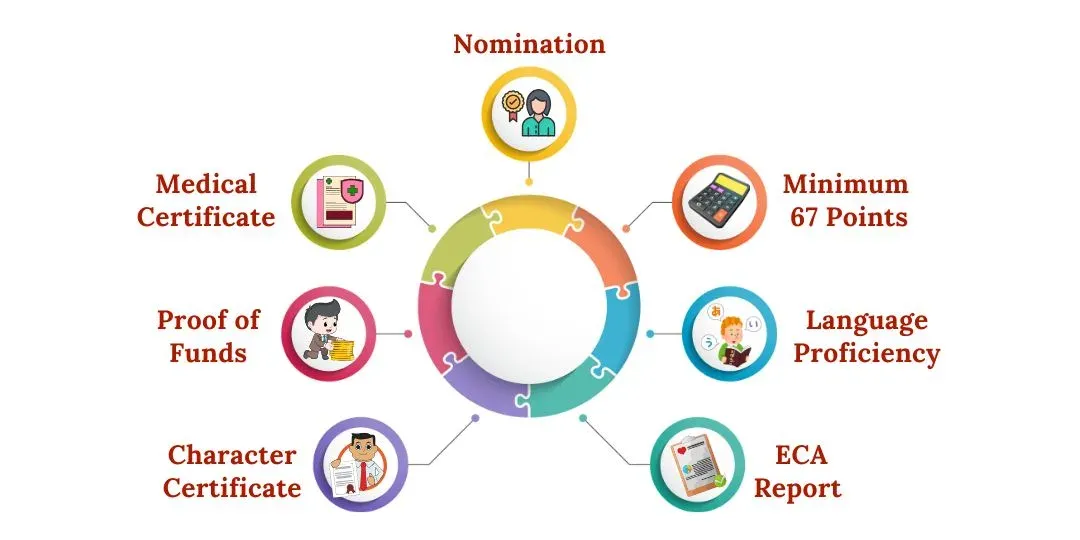
1. Nominated in any of the three visa streams (FSWP, FSTP, CEC)
2. A minimum 67 points on the point assessment grid or more to qualify under the FSWP (Federal Skilled Worker Program)
3. Language proficiency test score (either English or French)
4. Educational Credential Assessment (ECA) positive report
5. Medical certificate
6. Proof of funds
7. Character certificate
The above-mentioned requirements are some of the general requirements, which are considered necessary for a Canada PR visa application. However, while applying under other streams such as the CEC category, it requires an additional document such as Canadian work experience for at least one year.
Documents Required for the Canada Express Entry Program
Submitting essential documents while applying for a Canada PR visa is regarded as a crucial aspect. Essential document submission for the Express Entry Canada PR Visa is processed under two stages of the process:
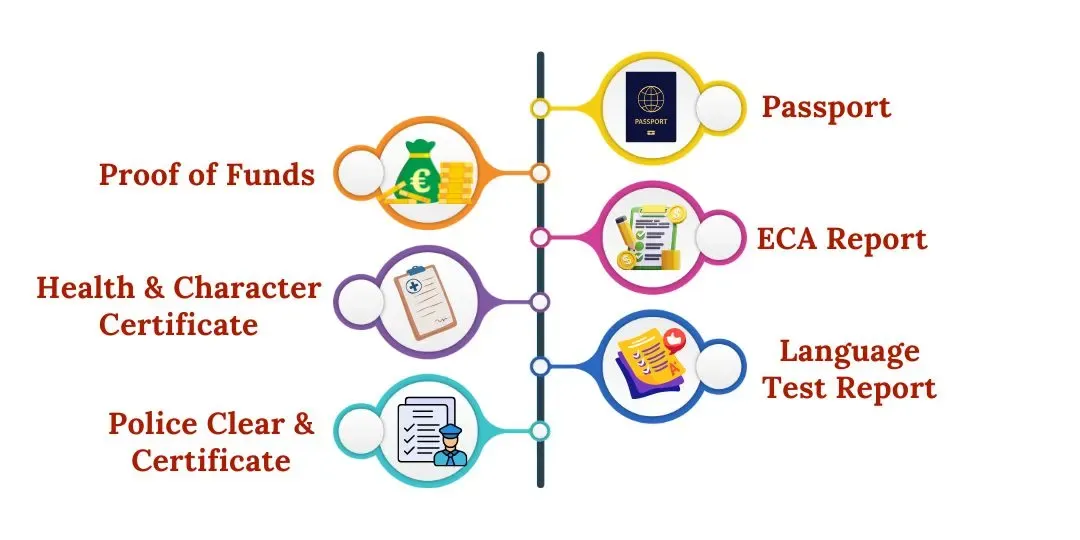
1. Profile Submission
2. Application Submission
For profile submission, applicants require:
● Passport
● ECA Report
● Results of the language test
● Employment offer (if received)
● Provincial nomination (if accepted)
For application submission, they require:
● Proof of funds
● Police clearance certificate
● Medical examination report
Sufficient Funds For the Canada Express Entry Program
While applying for the Canada PR visa through the Express Entry program, applicants are also required to display the proof of funds. Display of sufficient funds acts as an assurance to the Canadian government that the applicant is capable of managing and surviving in the country.
Number of Family Members | Funds Requirement |
1 (the applicant) | CAN $ 15,263 |
2 | CAN $ 19,001 |
3 | CAN $ 23,360 |
4 | CAN $ 28,362 |
5 | CAN $ 32,168 |
6 | CAN $ 36,280 |
7 | CAN $ 40,392 |
For each additional family member over 7 | CAN $ 4,112 |
Canada Express Entry Fees
Applicants applying for the Canada PR visa through the Express Entry program are required to submit the following fees alongside the visa application. Candidates are required to pay the Canada PR visa fee is after receiving an ITA (invitation to Apply) which is as following:
Application | Fees |
Application Fee | CAN $ 1,860 |
Processing Fee | CAN $990 |
Right of Permanent Residence Fee | CAN $600 |
Dependent child | CAN $270 (per child) |
What is the Canada In-Demand Skilled Occupation List?
Last updated: 19 November 2026.
What is Express Entry — Express Entry is not a visa programme. It is the online system Canada uses to manage applications for permanent residence under three federal programmes: the Federal Skilled Worker Program, the Canadian Experience Class and the Federal Skilled Trades Program. You create a profile, IRCC gives you a CRS score, and if your score is above the cut-off in a round of invitations, you receive an Invitation to Apply (ITA) and have 60 days to submit your application.
Federal Skilled Worker Program — For skilled workers outside Canada. You need at least one year of continuous skilled work experience, CLB 7 in English or French, an Educational Credential Assessment (ECA) for foreign education, proof of funds, and at least 67 points out of 100 on the six-factor selection grid.
Canadian Experience Class — For skilled workers with at least one year of skilled work experience in Canada in the last three years. You need CLB 7 for TEER 0-3 occupations or CLB 5 for TEER 4-5, and no proof of funds is required if you are already working in Canada.
Federal Skilled Trades Program — For skilled trades workers with at least two years of full-time work experience in a skilled trade in the last five years, CLB 5 in speaking and listening and CLB 4 in reading and writing, and a valid job offer or a certificate of qualification.
Besides your CRS score, category-based selection also matters: IRCC invites candidates in specific categories, such as French-language proficiency, healthcare, STEM, trades, education and transport, and the Labour Market Integration factor rewards high-wage occupations. The Canadian Immigration Authority, IRCC (Immigration, Refugee and Citizenship Canada), identifies this list according to labour market needs and increasing demand for certain occupations in various industries.
Also categorized as the NOC 2021 (National Occupation Classification) system, which identifies and categorizes jobs or occupations on the basis of training, education, experience, and responsibilities they require while discharging their occupations in Canada.
Earlier, the applicants were required to possess employment experience in occupations classified as NOC skill types 0, A, or B, referring to the 2016 NOC system. The 2021 NOC system has actively replaced the 2016 NOC system, categorizing them into various TEER categories. The TEER categories with some of the occupational examples are as follows:
≫ TEER 0
The type of occupation listed under the TEER 0 category includes all the management occupations. Some of the examples under this category are:
● Advertising
● Marketing and public relations managers
≫ TEER 1
Occupations listed under the TEER 1 category enlist occupations that require a university degree (Bachelor’s, Master’s, PhD, or Doctorate). Apart from a university degree, applicants do require a considerable years of experience in the particular occupation from the TEER 2 category (if applicable). Some of the examples under this category are:
● Financial advisors
● Software engineer
≫ TEER 2
The occupations sectioned under the TEER 2 category require applicants of a college diploma, apprenticeship training of 2 years or more years or supervisory occupations. Some of the experience listed under the TEER 2 category are:
● Computer Network
● Web Technicians
● Medical laboratory technologists
≫ TEER 3
The occupations sectioned under the TEER 3 category require applicants of a college diploma, apprenticeship training of less than 2 years, or more than 6 months of on-the-job training. Some of the experience listed under the TEER 3 category are:
● Bakers
● Dental Assistants
● Dental laboratory assistants
≫ TEER 4
Occupations listed on the TEER 4 category are those that require a high school diploma or several weeks of on-the-job training. Some of the examples listed under this category are:
● Home child care providers
● Retail salespersons
● Visual merchandiser
≫ TEER 5
Occupations listed under this category are those occupations that require short-term work demonstration and no formal education. Some of the examples categorized under this category are as follows:
● Landscaping and ground maintenance labourers
● Delivery service drivers
● Door-to-door distributors
Well, these are the TEER categories with their occupational requirements, crucial for prospective immigrants to understand before applying Canada PR application through the Express Entry program.
What is the Canada Express Entry Points Calculator work and How Does this Work?
Canada Express Entry points calculator, also known as the Comprehensive Ranking System (CRS) score which evaluates immigrants on certain parameters who aspire to immigrate to Canada and secure Canada permanent residency. The point calculator evaluates profiles on several measures, which are commonly known as The Six Selection Factors, such as:
● Age
● Educational Qualifications
● Language Proficiency
● Skilled Work Experience
● Arranged Employment
● Adaptability
Comprehensive Ranking System (CRS) for Express Entry Canada
How the CRS works — The Comprehensive Ranking System (CRS) is the points system IRCC uses to rank Express Entry profiles. Since 3 November 2026, the maximum CRS score is 1,270. Your score is made up of core human capital factors, worth up to 570 points for a single applicant or 530 with a spouse or common-law partner, skill transferability factors worth up to 100 points, and additional points worth up to 600 points.
Additional points — Additional points include 600 points for a provincial nomination, 25 or 50 points for French-language ability, 15 points for a sibling living in Canada as a citizen or permanent resident, and 15 or 30 points for Canadian education. Arranged-employment points are 0 since 25 March 2025, except for the Labour Market Integration factor below.
Labour Market Integration factor — Since 3 November 2026, a qualifying job offer in a high-wage occupation earns 50, 70 or 100 CRS points depending on the wage tier, and Canadian work experience in a high-wage occupation earns a bonus of 20, 40 or 70 points. You receive whichever is higher, and the two are never stacked, and no LMIA is needed. The maximum Labour Market Integration factor is 150 points for a single applicant, or 140 with a spouse or common-law partner.
Want to calculate your CRS score? Check Here
What changed on 3 November 2026 — IRCC replaced the old arranged-employment points with a new Labour Market Integration factor. A qualifying job offer in a high-wage occupation now earns 50, 70 or 100 CRS points depending on the wage tier, and Canadian work experience in a high-wage occupation earns a bonus of 20, 40 or 70 points. You get whichever is higher — the two are never stacked — and no LMIA is needed. The maximum CRS score rose from 1,200 to 1,270, and draws have been paused since 3 November 2026 while IRCC recalculates every profile.
How to apply — Step 1: Check your eligibility. Step 2: Take an approved language test (IELTS General Training, CELPIP-General, PTE Core, TEF Canada or TCF Canada). Step 3: Get an Educational Credential Assessment (ECA) for your foreign education. Step 4: Create your Express Entry profile and enter the pool. Step 5: Wait for an Invitation to Apply (ITA) in a round of invitations. Step 6: Submit your electronic application within 60 days, with medicals and biometrics. Step 7: Receive your Confirmation of Permanent Residence (COPR) and land in Canada.
Fees — A single applicant pays CAD 1,590 in IRCC fees (CAD 990 processing fee + CAD 600 Right of Permanent Residence Fee). Each dependent child pays CAD 270. Biometrics cost CAD 85 per person or CAD 170 per family. Fees are the IRCC schedule effective 30 April 2026.
Proof of funds — You must show you can support yourself and your family in Canada. The full IRCC proof-of-funds table is in the Eligibility & Requirements tab on this page: a single applicant needs CAD 15,263, a family of four needs CAD 28,362, and each extra family member adds CAD 4,112.
Documents you will need — A valid passport. Language test results. An Educational Credential Assessment (ECA). Proof of funds. Police certificates. A medical exam from an IRCC panel physician. Work reference letters. Photographs. Keep your passport valid for at least two years — an expired passport can delay your application.
Applying from India — Indian degrees need an Educational Credential Assessment (ECA) from WES or ICAS before you can claim education points. You can take IELTS General Training, CELPIP or PTE Core at test centres across India. Our Delhi office at Nehru Place guides Indian applicants through every step, from the ECA to the final landing.
Processing times — IRCC's service standard is about 6 months for the Canadian Experience Class and 7 months for the Federal Skilled Worker Program, counted from the date you submit a complete application.
Want an Invitation to Apply? Tips to Increase Chances of Receiving an ITA
Well, are you also seeking Canada permanent residency through the Canada Express Entry program but have scored less than the required CRS points, then just stay calm. Here are some of the tips through which one can improve or enhance their CRS scores if applying for a Canada permanent residency visa. Some of the tips one can follow are:
1. Improve Language Proficiency
Demonstrating language proficiency is one of the critical requirements for the immigration program, as it ensures the applicant's capability to survive in a foreign land. Canada, a bilingual country, accepts language proficiency scores in both the languages either English or French.
IELTS General Training, CELPIP-General, PTE Core, TEF Canada and TCF Canada are the language tests accepted for Express Entry. TOEFL iBT is not accepted for Express Entry — it is used for study permits.
However, if an applicant has scored lower band scores in any of the tests mentioned, one should consider retaking the language proficiency test with full confidence and preparation so as to boost CRS scores.
2. Take the French Language Test
Taking a second language test has always been considered advantageous. French can add 25 or 50 CRS points: 25 points if you score NCLC 7 in all four French abilities and CLB 5 or higher in English, and 50 points if you score NCLC 7 in French and CLB 7 or higher in English.
3. Enhance Educational Qualification
Educational qualifications are thus proved to be the foundation of every structure. Although applicants applying with an undergraduate degree also secure certain points, applicants applying with higher degrees fetch them additional points. In the CRS, education is worth up to 150 points for a single applicant: a bachelor's degree is worth 120 points, two or more post-secondary credentials are worth 128, a master's degree is worth 135, and a PhD is worth 150. A one-year post-secondary credential is worth 84 points.
4. Spousal Factors
Candidates applying for the Express Entry program who are not single can include their spouse or common-law partner while creating their Express Entry profile. Candidates with their spouse or common-law partner can claim an additional 40 points for their spouse's skills. Moreover, if your spouse's or common-law partner's credentials are more robust than yours, it is ideal for the candidate to designate their spouse as the significant candidate and receive additional points.
Lastly, these certain tips can help an applicant increase their CRS scores, thereby increasing chances of receiving an ITA (Invitation to Apply) for the Canada PR visa application.
Check your eligibility for free with Province Immigration — 14,000+ visas secured since 2015, and a Delhi office at Nehru Place. Call +91 98961 96762 or write to info@provinceimmigration.com.
How to apply for the Canada Express Entry program?
Applying for Canada PR through the Canada Express Entry program is a structured process which requires a systematic application process. Prospective immigrants can apply for Canada PR through Express Entry program from India in 2026 in such a manner such as:
Check Eligibility
While applying for Canada PR through Express Entry program, the foremost step an applicant must take is to check eligibility such as 67 points on the point assessment grid, occupation to be listed on the skilled in-demand occupation list with their valid NOC code, and sufficient funds.
IELTS and ECA Requirements
Once they are being assessed by the eligibility factors, applicants are required to move ahead with the ECA (Educational Credential Assessment) procedure and take the language proficiency tests such as IELTS, CELPIP, or TEF. Applicants must attain the minimum 6 points per band in each of the four modules such as Reading, Writing, Speaking, and Listening in the IELTS examination.
ECA (Educational Credential Assessment) is a procedure which evaluates and assess applicant’s educational qualifications according to the Canadian standards.
Create an Express Entry profile
Once the eligibility factors, IELTS examination, and ECA assessment has been taken care of, applicants are required to create an Express Entry Profile. Under this profile, applicants must fill in the application form, with all the accurate and valid information.
Submit Necessary Documents
After the creation of the Express Entry profile and completion of application form, candidates are required to submit essential documents alongside application fee. Some of the essential documents required for the Canada PR are:
● Valid passport
● ECA report
● Language proficiency tests score report
● Proof of funds
● Health and character certificate
● Police clearance certificate
After submitting these essential documents, applicants must submit the application fee and wait for the PR application decision.
Await Decision
Once the application fee is being submitted, applicants must wait for their visa decision. When received a positive response, the applicants will get an ITA (Invitation to Apply), which enables them to submit their application for Canada PR Visa to the IRCC within 60 days. Usually, Canada PR applications are processed within 6 to 13 months, depending on the program (Canadian Experience Class 6 months, Federal Skilled Worker 7 months, enhanced Provincial Nominee Program 7 months, base Provincial Nominee Program 13 months).
Get your COPR and Fly to Canada
Once the Canada PR application is being processed, applicants will get Confirmation of Permanent Residency (COPR) certificates, making them eligible to immigrate to Canada as Canada permanent residents.
How Can Province Immigration Help You?
We at Province Immigration have helped thousands of aspiring candidates who dream of immigrating to Canada and their family members through the Canadian Express Entry Program. Our qualified immigration experts are experienced in guiding you accurately by assessing your case and providing you with the best course of action for your unique situation.